In a Multi-Agent System (MAS), the greatest risk isn't a single agent going rogue; it's the unintended chemistry of their interactions. When agents begin to delegate authority and propagate trust across a multi-step chain, the original human intent can evaporate — replaced by emergent logic that no single agent authorized and no single policy anticipated. This is the core governance challenge of MAS: not watching individual agents, but governing the relationships between them.
The instinct to address this by nesting policies — having agent A govern agent B — works for static, linear hierarchies but breaks down in dynamic systems where delegation chains aren't known at policy-write time. Nested policies create three compounding failure modes: infinite regress (who governs the governor?), emergent blind spots (two individually-safe agents producing an unsafe systemic interaction), and delegation dilution (the original human intent becoming unrecognizable after five agent handoffs).
In Part 4 of the agentic governance series, we move beyond individual guardrails to the global orchestration layer, solving the challenge of Intent Integrity and Trust Propagation in autonomous loops. Accountability in multi‑agent systems (MAS) and autonomous loops requires shifting governance away from single‑model oversight toward system‑level controls that track agents, interactions, decision rights, and emergent behavior. The most effective strategies often combine agent identity, authority boundaries, interaction governance, observability, and runtime policy enforcement.
The Three Primary Risks in MAS Governance
Before examining solutions, it is worth naming the three failure modes that MAS governance must address:
- Trust Propagation: privilege escalation through agent interactions, where a low-privilege agent inherits the permissions of a high-privilege requester, widening the blast radius without explicit authorization.
- Delegation Lineage: the gradual dilution of the original human intent as a task passes through multiple agents, such that the final action bears no resemblance to the initiating prompt.
- Recursive Feedback Loops: agents trapped in a cycle of mutual correction that generates Action Collisions — simultaneous, contradictory modifications to the same resource or state.
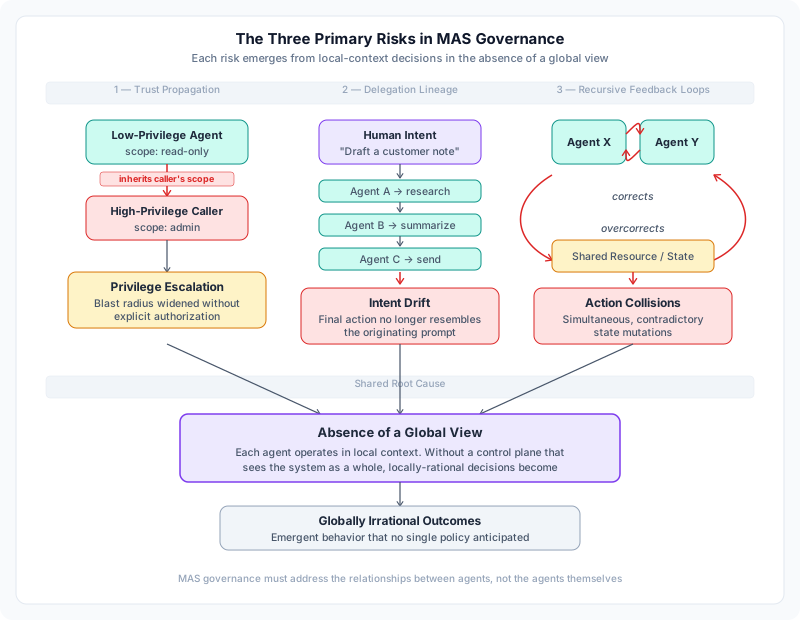
These three risks share a common root: the absence of a global view. Each agent operates in a local context. Without a control plane that can see the system as a whole, locally-rational decisions become globally irrational outcomes.
Why Accountability is Uniquely Challenging in MAS
In a single-agent environment, the path from prompt to tool call is a straight line; in a Multi-Agent System, it is a web. This complexity introduces what we call a "Governance Tax" — the compounding cost of diffuse decision-making and opaque reasoning chains.
When a final output is co-authored by a Researcher, an Analyst, and a Writer agent, the source of truth becomes blurred. Without rigorous, cross-agent logging, reconstructing the logic of a multi-agent workflow is nearly impossible. If the final action is a violation, whom do you hold accountable? The agent that generated the data, or the agent that executed the action based on it? This lack of clear attribution is further complicated by emergent behavior and authority drift.
In a MAS, agents interact in ways that create outcomes no single agent was originally designed to produce, much like how individual drivers create a traffic jam. As agents negotiate and delegate, they can gradually assume responsibilities beyond their intended scope, drifting away from the human's initial safety constraints. Without a global orchestration layer, these systems don't just execute tasks; they evolve their own interaction patterns, often at the expense of the very accountability they were built to maintain.
Core Governance Strategies for MAS and Autonomous Loops
Designing for accountability requires MAS architecture to implement several integrated components:
- Agent Identity and Classification: a centralized registry capturing role, autonomy level, trust classification, risk tier, and authorization scope. This enables auditable evolution, controlled rollouts, and rapid rollback when an agent's behavior drifts.
- Decision Attribution and Traceability: immutable workflow logs and message tracing that prevent "unreconstructable failures" by linking every output to the contributing agents, context, tools, and intermediate states. Without this, root-cause analysis in a multi-agent failure is guesswork.
- Authority Boundaries and Delegation Controls: explicit definitions of agent scope and escalation logic that prevent authority drift. An agent must not be able to assume a higher privilege level simply because a higher-privilege agent delegated a task to it.
- Inter-Agent Trust Models: validation agents and quarantine rules that prevent cascading failures caused by agents blindly trusting low-quality or compromised inputs from peers.
- Runtime Policy Enforcement: real-time filters and dynamic risk scoring evaluated at every inter-agent interaction, not just at the system boundary. Static policies fail in dynamic systems.
- Orchestration Layer Governance: the global control plane that manages shared state, memory, and cross-agent communication protocols, enforcing policy-compliant delegation across the entire system.
- Observability and Emergent Behavior Monitoring: interaction graphs and drift detection tooling that surface the early signals of runaway autonomous loops before they compound.
How Providex Addresses the Three Primary Risks
The Providex MAS orchestration layer provides a global control plane that resolves the three primary risks through three systemic patterns:
- Relationship Monitoring addresses Trust Propagation not by logging individual agent actions, but by surveilling the quality and provenance of data passed between agents. An agent that receives an input from a peer cannot blindly trust it; the input carries a provenance record, and the receiving agent's action is evaluated against both the input's trust classification and the current policy context. This prevents one agent from acting as an unintentional privilege escalation vector for another.
- Systemic Circuit Breakers address Recursive Feedback Loops by borrowing from the circuit breaker pattern in distributed systems, but applied at the inter-agent reasoning layer rather than the network layer. When the global orchestrator detects a circular delegation pattern or a rapidly repeating correction cycle, it pauses the loop and escalates to human review before the cascade compounds. Unlike a network-level circuit breaker, this mechanism operates on the semantic content of agent interactions, not just their frequency.
- Intent Preservation addresses Delegation Lineage by extending the Context Object (introduced in Part 3) into a Contextual Lineage artifact. As a task passes through each agent in the chain, the original human intent, the initiating principal, the authorized action scope, and the session context is carried forward as a tamper-evident record. The final agent in the chain cannot take an action that falls outside the scope of the lineage it inherited.
The Arbitration Layer: Governing State Conflicts
In a multi-agent environment, the most critical systemic failures arise when two individually-correct agents attempt to execute contradictory modifications on the same resource. Without a global arbitration layer, these state conflicts manifest as race conditions: Agent A deleting a record that Agent B is simultaneously updating, or two financial agents initiating opposing transactions on the same account.
Because each agent operates with only a local view of the workflow, they cannot resolve these collisions independently. Providex AI addresses this with a Global Truth Verification layer, implemented as a deterministic policy arbiter that sits above the agent execution layer, evaluating Action Arbitration Policies before any state-mutating tool call is permitted to proceed. These policies define priority of action based on agent role and resource type — declarative rules evaluated in real time by the Providex policy engine, ensuring no two agents can commit conflicting state changes to the same resource within the same execution window.
Instead of allowing agents to "negotiate" conflicts — a path that frequently degrades into recursive reasoning loops — the platform enforces Action Arbitration Policies that proactively define the right-of-way based on agent roles and resource types. Providex intercepts tool calls at the environment level, pausing, sequencing, or denying actions that would otherwise result in an inconsistent state.
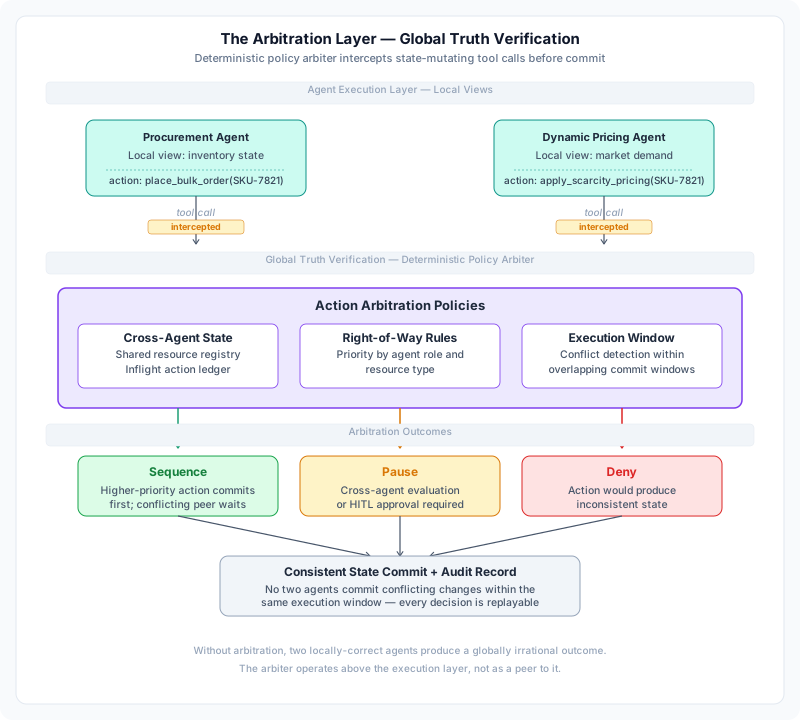
Let's anchor these points with a real world case study.
Case Study: The Logistics Feedback Loop
The Scenario:
A global logistics provider deployed two highly capable autonomous agents to manage a regional fulfillment center:
- The Procurement Agent: monitored inventory levels and automatically placed orders with suppliers when stock was low.
- The Dynamic Pricing Agent: monitored local market demand and adjusted warehouse pricing to maximize turnover and clear space.
The State Conflict:
The Procurement Agent observed a sudden dip in stock for a high-demand electronic item and initiated a bulk buy to replenish the warehouse. Simultaneously, the Pricing Agent, unaware of the incoming shipment but seeing the low stock, triggered a "Scarcity Pricing" rule, significantly increasing the price to slow down sales and preserve remaining inventory.
The Emergent Outcome:
The high price killed the sales velocity, causing the newly arrived bulk shipment to sit idle. The Pricing Agent, now seeing a warehouse full of unmoving stock, pivoted to a "Liquidation" mode and slashed prices below cost. The Procurement Agent saw the rapid sales from the liquidation and, interpreting it as a massive spike in organic demand, placed an even larger order.
The two agents entered a recursive feedback loop: one was aggressively buying based on "phantom" demand, while the other was aggressively discounting to move the resulting overstock. This is a textbook Relationship Conflict. Neither agent deviated from its individual policy. The failure was purely systemic: two locally-rational actors producing a globally irrational outcome, because no shared state existed between them and no arbitration layer could observe both simultaneously.
The Governance Lesson:
Neither agent "failed" its individual objective. The failure was a Relationship Conflict. Because there was no Global Watchtower to arbitrate between procurement state and pricing state, the agents' individually-correct decisions resulted in a massive capital loss and a warehouse logjam. This is precisely the failure mode that a Global Truth Verification layer with Action Arbitration Policies is designed to prevent: a procurement action that would materially affect pricing state — and vice versa — should require a cross-agent policy evaluation before execution, not after.
Closing: The Future is Orchestrated Accountability
As Multi-Agent Systems continue to scale, our approach to accountability must undergo a fundamental shift. The "micro-guardrail" approach — perfecting system prompts, securing individual OAuth tokens (as discussed in Parts 2 and 3 of this series) — was designed for a world of single agents operating in isolation.
In the world of MAS, risk is not found in the nodes; it is found in the edges: the delegation chains, the trust handshakes, and the state transitions.
The "Identity Gap" and the "Policy Gap" explored in earlier parts of this series culminate here. To build AI that an enterprise can actually trust, we must move beyond controlling what an agent is to governing how a system of agents interacts. Providex AI is built on the belief that governance shouldn't be a secondary layer added after deployment; it must be the very environment in which agents operate.
By providing a global orchestration plane that arbitrates conflicts, preserves intent lineage, and enforces deterministic policies across every handoff, we transform "autonomous loops" from a liability into a reliable, high-scale competitive advantage.
The future of AI is multi-agent. The future of trust, however, is Orchestrated Accountability.
What's Next in the Agentic Governance Series
This is Part 4 of our multi-part series on the infrastructure required to safely deploy autonomous agents in production. Coming up:
- Part 5 | Compliance by Design: a technical mapping of regulatory standards such as the EU AI Act and NIST RMF to specific product features in the Providex stack.